Tuesday, June 21, 2011

A Comprehensive Post on SEO

Share/Bookmark
I’m a blogger now but in a former life I did SEO professionally. As a part of the industry I’ve seen first hand the insane amount of misleading information available. Even so-called “professionals” have been known to give out absolutely terrible advice.
That’s why I’m writing this article. I want to finally teach you bloggers the truth behind SEO and how to rank well in Google. Some of the following information might be obvious and some of it might seem strange, but stick with me. If you follow my advice you’ll be ranking number one in no time.
The information I’m going to give is specific to Google, but the same tips will also help you rank in Bing and all other search engines.

Meta tags

Meta tags are a part of the HTML of your page that appear in the header. There are hundreds to choose from but only two matter when it comes to HTML: the Title tag and the Description tag.
Some people talk about the Keywords meta tag but Google has made it clear that they completely ignore it. It doesn’t hurt to have a keywords tag, but don’t assume it will help you rank in Google.

The Description tag

This is what Google (sometimes) uses to describe your site in the search results. It’s shown in the screenshot below.
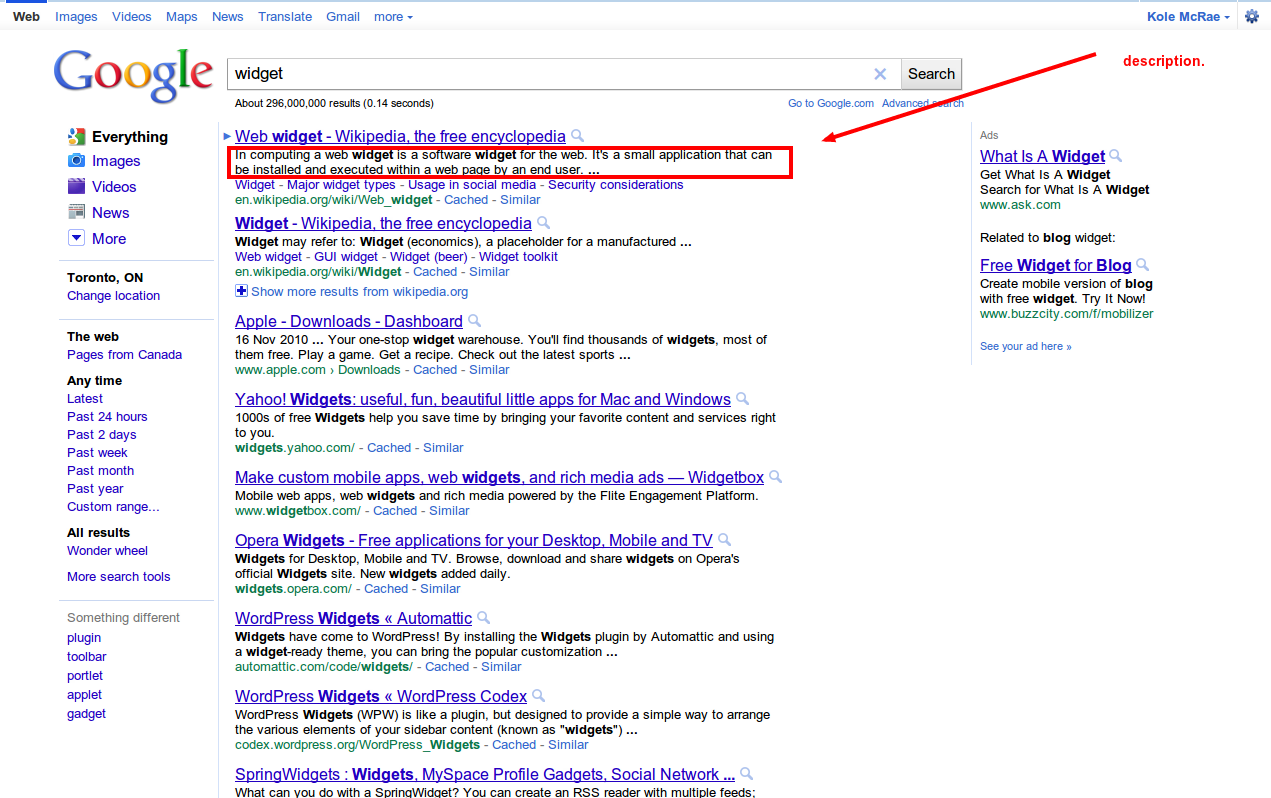
This does not effect your rankings, but it can be used to help entice people to click on your link in the search results. Make sure it is relevant to your site, and describes what people will find when they click your link.
As you can see in the screenshot, the term that was searched for will show up in bold in the results. You can use this to help get more clicks—but don’t abuse it.

The Title tag

The Title tag is (sometimes) used by Google as the main text of your link within the search results, as seen in the screenshot below:
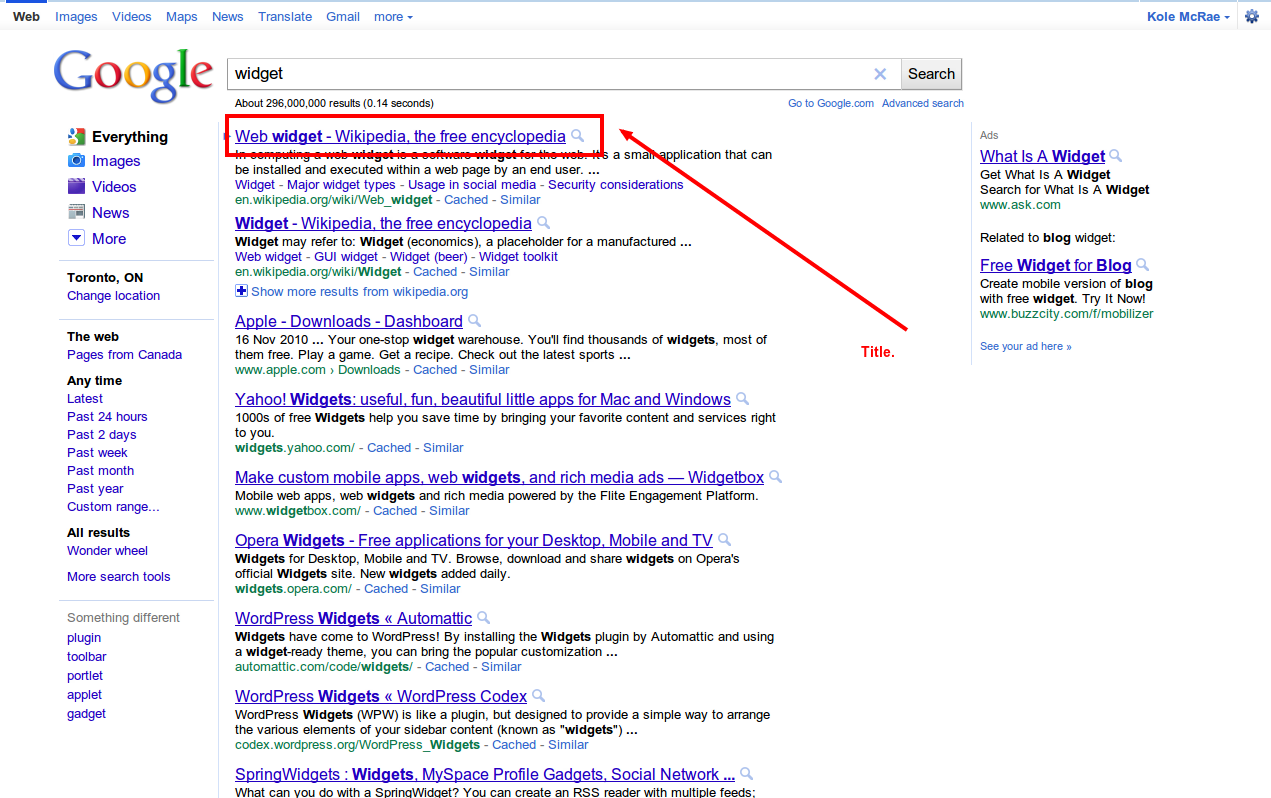
The words used here have been proven to help with rankings. Basically, the closer the keywords are to the left edge of the link, the better the result will rank for those keywords. For example, Geek Juice: Canadian Tech News won’t rank as well as Canadian Tech News by Geek Juice for the term “Canadian Tech News.”

“Sometimes”?

In both instances I said that Google sometimes uses these tags. This is because they sometimes use other sources. Google may display content from your site instead of your chosen description or title tag if Google’s algorithm believes it is more relevant. Google may also use content from DMOZ (the open directory project.)

Keywords

The tips I’ve seen online for on page SEO range from ill-conceived to downright frightening. People tout keyword densities and other strange points of data as the be-all and end-all of SEO. In reality Google hasn’t used keyword density in years. Stuffing a million keywords at the bottom of your page won’t help; some believe Google actually penalizes sites for this.
As long as you mention a chosen keyword once or twice within a blog post, you’ll be fine. The important thing is that the rest of the post is about that keyword. Google has figured out a lot of very complex ways to make sure your post is about the keyword you’ve chosen. For example if you’re talking about the keyword “Toronto Raptors” you’ll probably mention basketball and scores and various other basketball related information.
The best thing you can do when it comes to keywords is simply talk about the things you love.

Building links

Google first built its search engine on the idea of page rank: a page was probably relevant if a lot of people linked to that page. The more links to that page, the better. Early in Google’s life this approach was easily spammed, and to this day people continue to try and gain PageRank.
You’ve probably heard advice such as putting your link into blog comments and forums, and within your profile on social networking sites. The problem is that these days these links are all marked as “no follow” links. “No follow” tells Google not to use this link within its determination of the site’s ranking. So in the end, these links count for very little.
The only real way to build links is to create great content that sites want to naturally link to. The issue is that if you are a new blogger, your chances of getting a link are slim to none. There are ways to build them though…

Guest posts

Guest posts (such as this one) will almost always produce a really high-quality link to your site. Don’t guest post just anywhere, though. Google likes it when sites that are similar to yours links to you. So guest post on blogs that have similar themes.

Contests

Running a contest where you give something away is a great way to naturally product lots of links.

Viral content

If a single post or image of yours somehow gets to the first page of Reddit or Digg, you are guaranteed to get tons of links pointing to your site.

Social signals

Both Google and Bing have admitted to using social signals within search results. This is getting more and more prevalent.
However, it’s still a brand new part of SEO, and it hasn’t been thoroughly studied yet. What I can suggest, though, is that you make sure you have a Twitter and Facebook account and that you interact with your followers regularly.
Ultimately, all this advice amounts to one tip for achieving good search rank: create great, high-quality posts and interact with your readers regularly.
Are you doing this already? How’s your search rank looking?

Monday, June 20, 2011

4 Success Secrets of Infamous British Author, Jeffery Archer

Share/Bookmark
Love him or hate him, there is no denying the phenomenon that is Jeffery Archer. With 27 book titles to his name and international sales passing $250 million, Archer is a phenomenon.
So what can a man as successful as Archer teach you about blogging success?

Lesson 1: Blog about what you know

We have all heard that you should blog about what you love but, according to Archer, you should blog about what you know.
“I always say to people,” said Archer in an interview, “don’t write about goblins; don’t write about wizards just because they’re in. Write what you feel at ease with. Write what you feel good with.”
He gave the example of Jane Austen, whom Archer believes wrote well because she wrote about what she knew.
“Always remember Jane Austen. [She] lived in a small village, and wrote about her mother being unable to get rid of four daughters. Then she wrote about her mother being unable to get rid of three daughters. Then she wrote about her mother being unable to get rid of two daughters. Then she wrote about the daughter.
“And genius—you have to turn the page not only because of her wonderful command of language but because she wrote about what she knew about.”

Lesson 2: Be persistent

Archer’s first book—Not a Penny More, Not a Penny Less—was rejected by 13 publishers before being accepted. The 14th gave him a £3000 advance. Most people would not have had the persistence to keep trying after the first five or six rejections, maybe nine or ten if they were pushing it, but Archer kept pushing.
What was persistence worth to Archer? At last count, Not a Penny More, Not a Penny Less, has sold over 27 million copies worldwide. And that is just one of his 27 plus books.
So do not lose hope if a few blogs turn down, worse yet not respond to, your guest post submissions.  Do not lose hope if your blog does not open with a bang. Your big break might only be a submission away. Imagine if Archer had given up after the 13th rejection.

Lesson 3: Be a storyteller

The next lesson is that you do not have to be a great writer to be a successful blogger—but you do have to be a great storyteller.
What is the difference?
“I tell audiences all over the world,” explains Archer, “that a writer is someone who is very well educated, who has a tremendous command of language. Patrick White is a classic example. He is unquestionably, unquestionably a great writer, won the Nobel prize and he’s brilliant.”
A storyteller, on the other hand, “begins once upon and a time, and prays.”
While his definition of a storyteller is a little vague, the point he makes is clear. You do not have to have a MA in English to tell a tantalizing story but you do have to tell a tantalizing story to be successful blogger.

Lesson 4: Understand the importance of the inner circle

A woman once asked Archer how he got through his prison sentence.
“I just want to know how did you get through those two years being confined in a cell when you had the world at your feet? How did you get through? I mean, I know if I was put in a jail cell I’d probably commit suicide, I couldn’t survive.  I just couldn’t do it.”
“I promise you,” replied Archer, “you’d be fine if your friends stood behind you. I promise you’d be fine. I was inspired by and kept going by my friends. If they’d run away from me, if they’d deserted me, you’re right – I’d have gone under, I’d have given in. But they kept me going.”
This is probably the most important lesson. In order to survive as a blogger, you need someone to believe in you. You need someone who shares your mindset, who thinks it can be done or at least will support you till you find out either way.
You look at most successful people and they have all had someone who supported them through their journey. Goethe had his brother, who sent him money nearly his whole life. Stephen King had his wife who never complained. Jeffery Archer had his friends.
But it does not have to be someone you know personally. You can find an online community, like this one, which will keep you positive and connected.
Have you applied these lessons in your own blogging career somehow? Share your thoughts in the comments.

The Perils and Pitfalls of Blogging in College

Share/Bookmark
In March of 2010, during my sophomore year at Elon University, I started a blog called the Jersey Jets Fan as a way to exercise my passion for professional football. What originally started as a hobby evolved into much more than that, as I constantly looked to further promote my blog and slowly began to monetize the site.
In January 2011, I launched my second blog, BROcrastinator.com in hopes of capturing a large piece of the male college demographic. While, I’ve had varying degrees of success and made a few dollars along the way, I’ve learned a lot about the blogosphere. Balancing the work load of college as well as maintaining a full-time blog is a difficult thing to do and it certainly has its benefits and pit-falls. Here they are, according to yours truly.

Pros

Real business experience

College is a time in which you’re supposed to learn everything you need to adequately survive in the real world. As a marketing student, I’ve learned my fair share of terms, equations and statistics in college, but only blogging has given me the real world experience that will help me to become successful in the business world.
In the past year and a half blogging, I’ve joined various affiliate networks, spoken with a ton of potential advertisers, hired/fired/kept bloggers, worked with different partner sites and created business opportunities for myself on the way. I’ve never made a lot of money, but it’s been enough to offset the costs of up-keep on my blogs and even to splurge on a few items like new golf clubs.

Resume booster

Whether you’re applying for an internship in the summer, grad school or a full-time job, include your blog in your resume. When I was applying for an internship in sports marketing, my experience as a blogger with the Jersey Jets Fan was one of the key factors that generated employer interest.
A lot of people say they are interested in a subject or have experience in something, but not many people have the dedication to maintain and run an effective blog. If you do, don’t be ashamed, write about it in your resume and it might help you earn that job you’ve been striving for.

Self-esteem booster

Never in a million years when I started blogging did I ever believe my articles would be featured on Sports Illustrated or talked about on the New York Times website. It truly gives you a sense of accomplishment when you work hard and someone notices by featuring your work.
As a blogger who only gets around 400 views a day, sometimes I get discouraged when reading the “quick and easy” success stories of other bloggers who reach a million views overnight. Even though I’ve never had a viral post or even broken 1,000 views in a day, it makes you feel good when someone acknowledges your work.

Cons

Lack of time

While I originally started a blog because I had spare time in college, I soon realized the amount of spare time I had wasn’t enough to take my blogs to where I wanted them to go. There were points in time in which I was too spread out, writing for too many blogs, concentrating on too many social media sites, talking in too many forums. You only have so many hours in a day, and I’ve learned that you must spend them wisely on what works well for you.
At one point, I was writing for a prestigious New York Jets blog in addition to my own. While I was at first honored by the opportunity and experience, I didn’t have enough time to put full effort into both. Something had to give and as much as it pained me, the prestigious blog wasn’t as important to me as my college grades or my own blog.

Lack of capital

Like many of you, one of the reasons I began to blog was because of the chance to make money. I was never hoping for much, just enough for some spending cash on the weekends. However, there have been times when I started to believe the saying, “You have to spend money to make money”. Well, like I just told you, I am cash strapped college kid with a few spare dollars here and there but nothing significant. It isn’t the easiest thing in the world to launch a good looking website with about $100 while others out there are spending thousands.
I’m aware that my blogs aren’t the prettiest thing your eye has ever seen, but I’ve done my best with the money and technological skills I’ve had. While some older bloggers may have the spare cash to drop $10,000 on a beautiful looking website, college bloggers might have to quit at a $50 premium theme. I’m not saying you need money to build a good looking and successful blog, but it certainly doesn’t hurt.

Overcoming the difficulties

When blogging in college, or on any time constraint, it’s important to make sure you know your priorities. While I place school work over blogging, when I’m not studying, I use that time to advance my blog. I actually spend a lot less time doing school work then I did before blogging because I know I have additional work to attend to when I’m done. The most difficult times can occur during mid-terms and final exams when the stress of multiple classes all come crashing down at once. Sometimes, you just have to put your blogging goals on the backburner for a week, even if your visits and page views have to suffer.
In regards to the lack of money many bloggers have, I’ve learned to make the best with what you have. I originally started with a free WordPress theme and then moved on to a Thesis theme with a premium skin as my blogs advanced. By re-investing almost all of the money my sites have earned, I’ve been able to improve the design and even spend a little money on advertising. While I sometimes wish I had thousands of dollars to spend on my blogs, the reality is I don’t. However, with some smart money management and a little creativity, you can stretch your dollar and take it a long way.
There you have it, those are some of my main advantages and disadvantages to the college blogger. I hope I’ve shed some light on the topic, especially to you college students out there who are looking to potentially start a blog. It’s a tough thing to do, but it is certainly well worth it. I’ve found in blogging that you only get out as much as you put in, but if you put forth a ton of effort, you can find huge rewards.

Optimize the Most Underutilized Page of Your Blog

Share/Bookmark
Whilst it’s easy to get excited about crafting your latest blog post it’s far less likely you’ll be kept awake at night thinking about your blog’s Contact page. Indeed many bloggers don’t even bother to add a Contact page to their blog at all—but this can be a big mistake. As you’re about to discover, when contact pages are done right, they can become one of the most important parts of your entire blog…

The importance of your contact page

blogging
Image copyright kpwerker, licensed under Creative Commons
A key blogging concept that sets it apart from running a standard static website is the “community” element. Blogs are built for discussion and networking and any blog worth its salt will have a group of like-minded subscribers reading and contributing on a regular basis.
In the same vein, your Contact page is just one more way to interact with your blog visitors. Here are just a few of the many types of email you might get as a result of having a contact page—just take a look at all these benefits.

Site problems

Spelling mistakes. Grammatical errors. Broken links. Strange page alignments. Despite your best efforts sooner or later a few issues are likely to creep into your blog, either because you failed to proofread your writing before publishing, or because of changes to old posts that you haven’t noticed (such as the removal of photos you’ve linked to, affiliate programs closing down, or linked websites changing their site structure).
Sure, it can be both a little frustrating and embarrassing when someone contacts you to say that something isn’t quite right on your site but would you rather resolve the issue or leave the problem to run for the foreseeable future?
Making it easy to contact you allows your visitors to report any problems they are having with your site. That enables you to not only quickly resolve these, but to really take care of your readers by responding to thank them for the heads-up, apologizing for the situation, and telling them what you’ve done to resolve their problem.

Product review requests

Anyone releasing new products—from publishers to manufacturers—likes to get feedback on new products. It not only helps them make their product the very best it can be, but can also help to make their latest release more visible to potential consumers.
A highly-visible blog written by someone who clearly knows what are talking about can be an ideal avenue for this. It’s not uncommon for the blogger to be contacted in person and offered free products to look at that closely relate to the subject of their blog.
Without a Contact page, you make it very difficult for anyone to offer these to you. You miss out on potentially interesting and unique content, and freebies too!

Affiliate program invitations

The most profitable affiliate campaign I have ever run was as a result of being approached through the Contact form on one of my blogs. The gentleman who contacted me was one of the founders of a well-known online company who had since sold it and was setting up a new venture. He’d tweaked his sales process to within an inch of its life and was looking for a few beta testers.
That one affiliate program replaced my full-time income the day I added the links to my site.
And it was all because I ran a visible blog and was easy to contact. Without my Contact form, I’d never have been invited to join this “private” affiliate program and would be literally tens of thousands of dollars worse off.

Visitor questions

Ever wonder what your blog visitors really want to read about? Ever spend hours working on a post only for it to get little or no response from your subscribers?
Actually getting out there and surrounding yourself with your readers is one of the very best ways to create a uniquely tailored blog that’s perfectly in line with the interests and expectations of your audience.
And one ideal way to understand your visitors better is quite simply to pay attention to the questions you get asked. Look for common themes that you’re asked about on a regular basis and construct blog posts that specifically target these.

Advertising inquiries

A friend of mine with a small travel blog recently got contacted by an online advertising company which offered her a monthly advertising deal that, by itself, is equivalent to around 50% of the salary from her job. And all she has to do is paste a few adverts into her blog—a job that will take a few hours at most.
A 50% pay rise just for being easy to contact? Yes, contact pages really can bring in some amazing opportunities.

Media inquiries

The media constantly needs “experts”—for interviewing, fact-checking, raising awareness, consultancy and so on—and a visible and easily-contactable blogger makes a perfect target for these media professionals.
All these benefits from having a contact page on your blog that’s easy to find and encourages feedback? Hopefully you’re starting to see why you need to overhaul your Contact page! But what should you do to make the most of all these opportunities?

Contact page best practices

Make it easy to find

The first step with publishing a Contact page is to make it easy to find. Ensure that anyone who wants to contact you can quickly and easily find your Contact page.
A great service for helping you understand how easy your website is to use is UserTesting, where real visitors who have never been to your website are set assignments (such as “Find my Contact page”). They carry out these challenges on video while describing their thoughts so you can exactly how real-life visitors view your site, and how easy it is to navigate.

Encourage feedback

A well-designed Contact page doesn’t just provide information on how to get in touch with you—it actively encourages anyone reading your page to drop you a line. Let it be known that you love to hear from your readers, that you’re a real person and that you genuinely value their feedback.

Set realistic expectations

What should your visitors expect when they contact you? Try to improve the whole experience for your readers by giving advice on how long it normally takes you to respond to different types of queries, what type of contact you encourage (and what you simply don’t have the time to respond to), and so on.
Even consider giving tips on how you like to be contacted. For example do you prefer email, phone, Twitter, or Facebook? Do you prefer detailed messages, or short, to-the-point contacts? Are there any essential elements that your visitors need to ensure they include in their message to you?

List your social media profiles

Too many contact pages simply provide an email address on which you can be contacted. However, if you’re a blogger you’re probably involved in social media in a variety of ways, so your Contact page is another great place to list these profiles, thus offering more opportunities for interaction and growing your social network.

Add a Contact form

There are two problems with simply providing an email address on your Contact page. The first is that there is a risk your email address will be harvested by spammers who will then bombard you with junk email. The other is quite simply that you make it more difficult for people to contact you—and as a result you will reduce the number of messages you receive.
While it seems like a tiny thing having a Contact form that readers can fill in and send straight from your Contact page will make life significantly easier for your visitors and so encourage them to contact you.
Does your blog have a contact page? Has it helped you connect with your readers, the media, and others? I’d love to hear your thoughts in the comments.

A Blog, a Book and a Business: One Author’s Journey

Share/Bookmark
This guest post is by Kevin Cullis of MacStartup.com.
I don’t like writing. Or should I say, I used to not like writing. My reason? I found no reason to write other than writing a college paper or something for work; it was a requirement; I had to do it.
I was bored with my computer sales job and still had plenty of talent and motivation to do something—but nowhere to channel it.
book
copyright matttilda - Fotolia.com
One day at work I had an idea: use my talents to write about my experience. Initially I had no clue where this was going to lead me, much like spontaneously taking a late night drive on a country road and only seeing as far down the road as your headlights will shine: let’s just head out into the open road of writing and see where it leads!

My book idea

To start, I just began writing, and days turned into weeks. My idea was to combine both business processes and computer solutions into one content document, not separating these into one subject or another and then into finer and finer details like other writers have done.
This writing was different from my previous efforts: I now had an outlet for my pent-up boredom and an engaging interest in my subject matter because it combined both my talents and experience selling computers to businesses.  In addition, I had daily, ready-made access to content and a list of potential readers.
Whenever I came across something relevant in my work, I wrote it down—both the problem and solution. As my writing began to take shape, I organized the information into specific and logical sequential steps for my future potential business readers. My realtor wife even became a guinea pig in my endeavor. When I heard the familiar “Honey, I need some help,” I’d go in to help her, taking notes, and writing the solutions down when I was done.

Now for my blog

One day, a business customer recommended turning my writings into a book, and wondered when it would be done so she could buy one. Until then, it was just a writing idea, but now my idea took on a larger goal: to get a book published. I was now seeing farther down that lonely country road with larger and brighter lights of my writing journey.
In 2009, I started a blog because a fellow author said that during the one to two years it would take to write a book, my writing would improve and change. Talking with other bloggers, I was told that 250-750 words was an appropriate length for a blog post—and similar to having a goal of writing 1000 words a day for a book. Writing a blog would provide another outlet for increasing my monthly goal word output, and improve my writing skills. Later, I found out that blogging allows one to test out content ideas online and provides both personal and additional perspectives for the readers of the book. Also, an author’s blog almost always points to that author’s book.
In the spring of 2010 I attended the Colorado Independent Publishing Association conference and connected with other professionals in the publishing field. There, a local editor suggested that I use an initial (raised or drop) cap in my book design. I couldn’t afford Adobe’s InDesign or to pay someone to help me. I used Apple’s iWork Pages to write my book, and I had to eat my own dog food. But I did not know how to create a drop cap in Pages.
So I spent three hours finding the answer and, rather than lose this experience because of my infrequent use of it, I posted it on my blog. Within weeks it rose to near the top of my most-viewed articles, and still remains one of my most popular blog posts.
Not only were people hungry for my information, but I have personally referred to my site using my own blog to find long forgotten answers to problems. And if I hadn’t blogged about it, I’d have to revisit the process again. Oh, and when I showed my printed proof to the editor, she didn’t believe that I used a $79 office suite to produce what I did until I showed her the file on my laptop. Then she gave me a B+ for my results.

Book, blog, and business working together

As both my book and blog posts progressed, my blogging experience awakened me to how a blog could be more useful for me. Over time I began noticing trends in my blog statistics. An affinity surfaced when I looked at monthly, quarterly, and even yearly post view counts. Using this information, coupled with my day-to-day interaction with business customers needing computers, I was able to get a much clearer vision of my content for both my book and blog.
When I first blogged, I considered it to be like shooting in the dark in terms of working out what to write about, but over time this multi-sourced feedback helped provide me with content direction. Writing my blog also helped change my book’s content to today’s third version. It’s one thing to scratch your own itch, but it’s even more motivating to get actual, statistical feedback from others who have the same itch that needs scratching.
Going forward from today with my blog, I’ll be using Google Analytics and keyword research to help determine what people are looking for, so that I can provide immediate answers to my ideal blog audience. Using this approach will help narrow down my potential content and solve a customer’s points of pain in the short term, but I have also found that it may not provide a good focus for all of my content. Here’s why. Answers people are searching for comes in two forms and everything in between: I know what I want to know (my drop cap example), and, I don’t know what I want to know (I have no clue what to look for).
The first search is easy. The second one is more important, but it’s solved by awareness and education.
So my future content will take on many forms. While some of my blog posts might be the “thrill of the road hot rod” looking for an adventuresome driving experience of immediate answers, be sure that I’ll also provide “slow, steady, reliable transportation” posts to educate my blog readers to find the right answers to their many different journeys and destinations.
AJ Michalka’s song title states it right—It’s Who You Are—so I write my blog posts about my subjects because it’s who I am. And watch out for the occasional spontaneous “road trip” breakout blog post occurring before a long weekend that just might shake things up a bit.
Can you see potential in your work, interests, and life to combine blog, book, and business? I’d love to hear your experiences in the comments.

Related Posts Plugin for WordPress, Blogger...
Twitter Delicious Facebook Digg Stumbleupon Favorites More

 
Join Bloggerative on Facebook Follow Bloggerative on Twitter Subscribe to RSS Contact Bloggerative
Sponsored by iPhoneMY