Thursday, August 11, 2011

8 Ways to Earn Money with Digital Photography - How to Sell Photos Online

Share/Bookmark

Are you a shutterbug? If you like to snap pictures at family events or just out in the neighborhood, put that camera to good use in ways that will earn you money for your efforts. This article mentions eight ways that you can make money with digital photography.

The world of photography has changed since the instant camera was developed. With a digital camera, you can take a not so good shot and make it perfect using a variety of software options. Best of all, pictures can be printed on quality paper on your printer or at a store kiosk for just a few cents per picture.

Technology has created memory cards much like the flash drive storage medium to file and save pictures for sharing on the Internet. You can easily upload pictures from the memory card to your friends, family and a blog or website if you have one.

1. Stock photography
This business is growing. For website newsletters, magazines and articles, publishers look for photos that capture the essence of their articles. It is not terribly convenient to go out and snap some pictures every time you need one. Selling stock photographs to businesses and individuals is convenient for them and lucrative for you.

2. Wedding photographer
Okay so if you aren’t a professional you won’t be the main photographer at first but you can be hired to take candid shots at the reception or wedding photos after the ceremony. The happy couple can order as many pictures as they want and you can create wedding CDs of the pictures you took.

3. Newspaper pics
If you are in the right place at the right time, you might capture photos that are worthy of the newspaper. When news happens, a newspaper photographer might not be on the scene. You can capture the moments and sell them to newspapers. Snapping shots at community events may also earn you some money from local newspapers.

4. Magazine photographer
Create a portfolio of photos that you’re taken and submit them to magazines. Looking at your work, they may hire you for assignments. Magazines are a tough market to break into so cut your teeth on other smaller assignments for local newspapers.

5. Local photography business
Ever gotten a mailing that shows cars for sale or houses for sale? Someone had to take those photographs. It could be you. Hire yourself out to area businesses to do the photographs for them.

6. Event photographer
Some families like to document their events like family reunions, christenings, bar mitzvahs and birthday parties. You can be the eyes in the room catching candid shots of everyone.

7. Photography website
If you know a lot about digital cameras and photography, create a website to sell photography products. Keep visitors and customers coming back with engaging content on various aspects of photography.

8. Teach a photography class
Those cameras look easy to use but some of those symbols can mix people up. Teach others to use their digital camera and create great pictures that they, too, can market as a business.

Do you like photography? What started off as a hobby can become a new business venture.

Top 10 Traffic Ideas For Your Blog - Generate More Web Traffic!

Share/Bookmark
Blogs are popular ways to create an online presence for personal and business reasons. You can build a blog for free and begin posting content right away. But, what good is that content if no one is reading it. Here are ten ideas to bring in the traffic your blog needs to survive.

Of all the successful blogs on the Internet, hundreds more have failed. Running a blog is like running a business website. Unless you are willing to put the time in and treat it seriously, you won’t be blogging long.

That is not to say that the failed bloggers weren’t serious about blogging. Mostly, new bloggers aren’t prepared for the work that goes into creating a successful blog. Just building the blog doesn’t mean that people will necessary come to you. You pursue the audience and give them a reason to see what you have to say.

1. Fresh Content
No one wants to visit a blog day after day and see the same posts. Update your blog content at least twice a week. This will be easier if you write several posts ahead of time and upload them at the appropriate times.

2. Article Marketing
The niche you’re chosen for your blog is one that interests you. If it is interesting you will spend more time doing it. Create content not only for your blog but also to be submitted to article directories. Use the resource box to advertise your blog so people can find you. Article Marketing Robot is a popular software to register accounts and submit your articles to over 2000 articles directories automatically.

3. Social Networking
These sites are everywhere. Join Facebook, MySpace, Squidoo, Twitter or a dozen others and make connections. You can join groups of likeminded people who are also bloggers or entrepreneurs.

To make social marketing more effective, many marketers will also use tools. The most powerful and popular tool among them is SEnuke. It can automate and schedule all web 2.0 social marketing tasks, including social bookmarking, posting on social networks, video sharing, RSS, builking forum profiles and web 2.0 profiles, press release, etc.

Another choice is Synnd. While SEnuke automates tasks by software, Synnd do it by outsourcing to other thousands of members.

4. Viral Marketing
This is where you spread the word about your blog. Talk to friends, family and even strangers. Give out business cards that have your blog address on them. Install Viral Friend Generator script on your website to drive visitors to tell their friends about the site.

5. Use RSS Feeds
RSS stands for really Simple Syndication. Readers can subscribe to your feed and get email updates when new content is posted. It is an easy way for them to keep up with your blog without spending all day online.

6. Submit Blog to Search Engines
Doing this allows your blog to be ranked. Google and Yahoo! are two of the most popular search engines you want to crawl your blog pages. It doesn’t guarantee top ranking, though. You’ll have to do a little more work for that.

7. Joining Forums
As a blogger you are a budding entrepreneur. Right now you are marketing yourself to find traffic and then profit. Become a member of business forums, work at home forums and others to meet new people and share ideas. You can add a link to your blog in the signature line so others can find you.

8. Visit other blogs
Show your appreciation to those who visit you by also posting comments on their blogs. It is a kindness that shows others you are not just out to advertise your blog alone. Add links to your blog in your comments. Remember, don’t just say something like “Good post!”, it will be regarded as spam. Make contribution. Decent comments can add value to the original post. It will make your comments sticky. You can find relevant blogs manually by searching or use tools to make it more efficient, such as Blog Comment Demon.

9. SEO Marketing
Whatever you write, use relevant keywords. Keyword density between three and ten percent is good for getting higher page rankings in search engines. Base your keywords on a research you do to find the most popular words used in search engines for your niche.

10. Social Bookmarking
Submitting posts to social bookmarking sites allows others who are members of those sites to track you back to your blog.

Using any of these ideas will start the traffic moving in your direction. It takes time but you will build the readership you want.

Blogging Platforms, Which Is Right for You?

Share/Bookmark
If you are going to blog, you’ll need to choose a platform. A blogging platform is the software or service provider that has established the blog format you’re using. In the world of blogging there are several well known platforms you can use…

* Blogger, owned by Google
* Typepad
* WordPress


Other blogging platforms include:

* MoveableType.org
* Joomla 
* And many website hosts have proprietary blogging functionality.


How Do You Choose a Blogging Platform?

* Price – Many blogging platforms cost money. For example, Typepad requires a monthly fee. WordPress however, is free. Price may be a very real decision maker for you.

* Options – The more popular the platform the more options you have. For example, WordPress has thousands of people developing templates, plug-ins and other functions. If you plan on doing a lot of different things with your blog then you may want to go with a blog platform that offers myriad options.

* Ease of use – How easy is it to use the interface? Some platforms are intuitive and you don’t have to open a page of your user manual or put the help desk page on your bookmarks. Other platforms feel as if they require a technology degree to work with. Explore the various interfaces and find one that feels comfortable to you.

* Navigation – Can you create a blog that will offer easy navigation for your visitors? Presumably you’re blogging with the intention of attracting readers. Does the blogging platform support a good reader experience?

* Features – Does your blog meet all of your needs? Again, the more 
options you have the more likely a blogging platform will meet your needs – from ecommerce to membership sites or information marketing. 

* Customization – Can you easily make your blog look and feel exactly like you want it to without a ton of work, time and money?

* Reputation – Does the blogging platform have a good support system? Are you able to find or get answers when you need them? If they host your blog is there ever downtime where your blog is inaccessible? 

Before you choose your blogging platform decide:

* What you want your blog to accomplish
* What you want your blog to look like
* Where you want to host your blog
* How much you expect your blog to grow over the next couple of years.
* How much time you have to devote to your blog
* How much you want to spend on your blog


Once you have the answers to the above questions you can begin to compare your options. Spend time on this decision. Moving your blog to another platform won’t be fun or easy. Choosing right the first time will save you time, energy and money.

The Best Facebook Advertising Strategies

Share/Bookmark
Facebook advertising can be a great way of getting targeted traffic because it can offer you many options to target your traffic and owing to the popularity of this social site and with its millions of active users. But advertising on this platform is a bit expensive as many marketers have observed. 

Display advertising is more effective on this social site as many web marketers have observed and Facebook can easily display advertisers with their easy accessible open platform. Many small and medium sized marketers and advertisers who want to establish their brand are turning to this ad platform.

While Facebook advertising may be more expensive than other online ad campaigns, if you want branding as your objective you can still make use of this campaign. While this may not be the cheap and cost effective channel for you, it may still give you the success by doing a smart ad campaign on this social channel.

You can still make the most out of your campaign on this social site if you can really do the smart advertising that you have to do. You can make the best Facebook advertising strategy if you do the methods below for your ad campaign on this social site.


  • The first thing that you have to do is create an ad and include the URL of the page that you want to send your traffic to. The best place to lead your visitors to can be your fan page because this can be the best and interesting plan for your visitors.
  • The best method where your potential visitors may make notice is the use of images in your ad copies. An effective Facebook advertising strategy is to use an image of an attractive man or woman which makes your ad have effects in which the image may have impressions as if directly talking to the viewer.
  • Attractive personalities can command attention and this method may get get your prospective viewers to view your landing page or fan page. Your prospects may see the image as yourself speaking to them directly and invite them to your fan page.
  • Get high click through's with this image strategy and it is better if you can find the very relevant image to use. This may be a bit a hard thing to achieve, being difficult to identify which is relevant, but you can still get one with a little patience observed.


Always remember that your objective must include getting a high click through rate because this is the greatest factor in determining whether you can effectively lower your ad costs or not even with the reputed expensive campaign on Facebook your high click through rate may still lower it.

5 Excellent Tips to Know When You Get Blogging Advice

Share/Bookmark
When you start blogging there may be lots of things that you want to know and lots of things that you need to figure out. This can be for any number of reasons - to get more people to read what you have to say, to make more money, to share your passion with other like minded people. Now, instead of taking years to find out all the secrets to these things there is a simple way to get all the best blogging advice you can. You got to get a guide which provides blogging advice that discusses all the details around blogging and how you can turn your passion and interest into a full time business.

Here are 5 excellent tips you need to know before getting any blogging advice.

1. Specific info - Your guide got to have every detail about blogging that you can think off including the discoveries and information shared by the author. The guide got to be very specific and offers a lot of useful information that really helps. From experience, I do get many ebooks and guides that you will find will give you a lot of meaningless stuff and not very specific info, perhaps for fear of giving too much away or something.

2. Author’s philosophy - If I were you, I do look for author who has the philosophy of giving more, by telling everyone the secrets to successful and profitable blogging. He does this as he knows it is not going to harm his business in any way. It is a win win situation and you will be spending good money for all this information.

3. Step by step instructions - Blogging guide which you buy got to have step by step instructions. With these, it makes it easier for any blogger to understand and to set everything up Preferably, the guide includes step by step screen shots of all the details and during your blogging process, this will be a perfect handbook to refer to at any time to help you along.

4. Resources - Your blogging guide must offer you other websites that you need to join, where to find links that will pay you, and how you can get the best keywords to use to optimize your blog site in the correct way. All the details that you need to know about the setting up, the maintaining, the planning and the profit making are all listed in this not too long, very comprehensive eBook.

5. Setting the stage right - The last important factor is that the author does share with you the right mindset of setting up a blogging business. The blogger, who is successful, knows what you got to take to be as successful as him. He knows that for you to know the technical stuff is not enough. He educates you to learn and digest about the type of mindset a successful blogger needs to have.

It is with these details that you can thrive and is great for those that don’t really have a lot of spare time to learn the ropes of the internet and blogging world. You just need to follow a blogging guide book and take all the blogging advice that you can get from it. When you get the right guide book, it will become a one stop shop with helpful hints, great resources, links to websites and tools that you will need to use, things to avoid and not only this, but it will basically tell you in order just what to do and how to do it. With the right book, you will not need to use another eBook or blog guide ever again if you get the right one and you will soon be making a great amount of money from this venture.

John Yeo is the author of Bloggers Pay Check. He is a pro-wedding blogger and social worker who generates $2000 each month of passive income just from his one wedding blog.

Source / Author : John Yeo
Repost by : Exabytes.com.my

SEO Tip: Optimizing The Landing Page

Share/Bookmark
The landing page is that web page where you lead your prospective customers after they click on your ads or on a link on the search results pages. This web page will display all the relevant information that you want to relay to your prospective customers.

The importance of the landing page is to be taken with great consideration because this page will determine the success or failure of your marketing campaign. The actions that your prospects will show when they are on these pages will show if your landing pages are effective or not. 

For your landing page to be effective you have to show its relevance and have it optimized for it to be effective. in optimizing your landing page, these things found below have to be done.


  • Your landing page content has to be relevant to be effective, and will not lead your prospective customers to click back because of non interest with your contents. These pages should be attractive and compelling and the use of your keywords will be needed here.
  • For better results do not make your homepage be your landing page because the prospective customers may get disinterested outright. Show contents in your landing page that are informative and beneficial to your users and you can lead them later to your homepage where your products features are displayed, including the added benefits they can get from the products.
  • Include a strong call to action in your landing page. Although this may sound forceful but do it in a subtle way so that it will not overwhelm your prospective customers and these things may be in the form of sign-ups for free emails or anything useful to users.
  • You have to keep your landing page free from all the unnecessary clutter that will just make your prospective customers go away or click back to search or the previous page where they come from. Make your landing page easy for the prospects and not bore them.
  • Make efforts to make your visitors stay in your landing page like providing information that may have a continuation in your other pages. Provide a link to these inside pages and this will add up to curiosity of your prospective customers.
  • Make your landing page simple yet compelling and attractive. Do not make your prospects more confused with what you provide in your landing page and provide only easy to understand and information or instructions.
  • Providing free things in your landing page will add more to its attractiveness. People usually go for anything free and providing these freebies in your landing page will add more to its effectiveness to the prospective customers that clicked on your ads or on these links in the search results pages.

A General Overview For Google SEO

Share/Bookmark
Due to the technology of today people can have their web business get the success even if they are only new to the business or only a small time business owner. With the internet and the search engines, a small web business owner can be at par with the big businesses around. Small businesses can have all the opportunities on getting the quality traffic to their website, courtesy of the top placements in the search results pages where many people can have a good view of their website. This is courtesy of the search engine Google and the SEO strategies implemented to get these high placements.

Search engine optimization can be successful if on page optimization is done to the site, like making all adjustments needed on the webpage content to get the high rank possible. Getting this rank is also needed for links to be created, and strategies to get the links can be one of the things enumerates.


  • Ask for them, and this can be through posting comments or linking to other relevant sites and requesting them. This is a hard thing to do and quite impossible to think but you may still be lucky and get the links.
  • If you submit your site to the relevant directories you can get one way links from this method. If you have articles and submit these to the article directories you can have one way links, especially if you submit to RSS feeds for syndication.
  • Utilize forums and you can get probable links from forum members. Finding the appropriate forum in your market will be a good strategy for SEO and you can get the relevant links from these people.
  • Use blogs in getting the links. Creating quality blogs and submitting these to the popular blog platforms in the net can bring you plenty of these links needed for your SEO ranking objectives.
  • The social media can be used also to get plenty of link possibilities because of its high popularity. Get an account with these social sites and you can have these link possibilities.


In SEO with Google the kind of links is given more importance in the site ranking process. Links coming only from the relevant and high ranked sites can get you the high rank that you desire. Do not go for buying links because this may not get you the success of your search engine optimization ranking efforts, and these links may not be the relevant links, at all. It can be better if you go only for the relevant links, those from the reputable sites because in Google SEO the quality of the links can be more effective than the quality of these links.

Why You Should NEVER Hire a Social Media Manager

Share/Bookmark
This could be a very controversial post for many, however this must be pointed-out. It seems like social media "gurus" are a dime a dozen in today's time. In lieu of this, businesses must be extremely cautious about who they select based on the results they're seeking. 

Listed below, are three reasons you NEVER want to hire a conventional social media manager.

1) A large majority of all social media managers have no experience building a brick-and-mortar business or a highly profitable online company using the web a nd social media.

How can you expect a person (or company) to help you substantially grow your business with the internet when they don’t actually have experience personally doing it? Just a word of wisdom. Do not even think of hiring someone that doesn’t have a long personal track record of success.

I should hope that’s a bit of common sense.

In reality, most individuals waste time with social media and only a tiny fraction of businesses actually generate worthwhile income with it. You'll find that with inexperience comes poor strategy and consistent obstacles.
I'm reminded of a quote…. “You can either make friends with social media or you can make money, but you can't do both.”

2) Expect to pay a lofty premium if you’re going to hire a person with a bunch of experience.

Now, I should point-out, there IS a time and place to pay a high premium. Price should not be the deciding factor, the proven results-based track record should. You will pay for quality most of the time.

The ballpark average experienced social media manager salary (if they’re worth anything) starts at over $70,000 per year. Remember, this is an employee you’re bringing-in to your organization, not an entrepreneur with a strong eye towards growth.

I'm sure you'd agree, employees need guidance in most cases. They don't just take the baton and run with it.

For the average small business owner, paying over $6,000 per month isn't feasible, especially when your company is forced to commit to a six month contract or more.

A big corporation will easily invest this amount monthly but it's not advisable for other businesses doing under a half a million per year. Don't count on finding someone off of Craigslist to make the marketing profitable and effective, too.

Far too many companies do this and they end up guessing at why “social media does not work.” The reality is, social media works, it’s just that your strategy sucks.
Managing social media is one aspect. Aggressively growing your company is another.

3) Your social media manager will not have enough time in the day to do everything that needs to be completed. In order to be successful, you should have the following online marketing methods working for you around the clock:

- Keyword and market research
- Facebook organic marketing
- Facebook ads (ppc) marketing
- Online video creation
- Online video submission / optimization
- Podcast creation / submission
- Search Engine Optimization (SEO)
- Articles written and submitted to top directories
- Press releases written and submitted online
- Google Places optimization
- Blog creation and post updates regularly
- Backlink building
- Directory submissions
- Google organic marketing
- Google Adwords PPC management / optimization
- Automated reports generated to track results

In truth, it’s practically impossible to find a social media manager that has experience doing everything listed above. If you can, you'll pay a big premium. Realistically, you need to have a TEAM of experts working on your behalf.

Social media is just one piece of the internet marketing arsenal. If you leave-out the rest you won’t get very far. Knowing these 3 key points, you now have a simple choice to make.

Would you rather pay an inexperienced social media manager $70K+ per year to “try” to build your business with Facebook, YouTube, Twitter, etc..?

OR…

Would you rather hire a specialized team of experts with a time-tested strategy (at a small fraction of the cost) that has experience selling MILLIONS of dollars worth of products / services from the web?

If you’re smart, committed to business growth, and choose the latter, here’s the perfect solution for your individual business needs.

4 Steps to Making $100 Per Day on the Internet

Share/Bookmark
4 steps to making money online - sounds simple right? Well, making money on the Internet is not difficult. It requires understanding of a few basic principles. However, you might think getting started online is a difficult thing if you look at the thousands of products catering to the Internet marketing scene. But all it takes is a few simple steps to start making profits. Focus on these steps and you'll bring in money!

Don't be a complete perfectionist and wait until all the conditions are right or when you have all the information you need. The conditions will never be 100% perfect and you'll never have all the information out there. Just concentrate on the major things that will affect your profits and you will start making money, then you can make adjustments to your business model.

Here are the 4 steps to making $100 per day on the Internet:

1. Find A Niche
Find a topic that you are interested in and has demand. Having interest in the topic isn't a must, but it's a big plus as your enthusiasm will ensure that you have quality products and quality marketing materials. But your niche has to have demand.

2. Create A Website
You will need a website as the foundation to build your business on. Personally, I like setting up simple opt-in pages to capture subscribers. You should always get your visitors to subscribe to your mailing list so that you can market to them for months and even years.

3. Build A Mailing List
Use an autoresponder to build your list. The ones I use are Aweber and Get Response. There are other options like I Contact and 1 Shopping Cart. Choose wisely because the autoresponder you choose will host your subscriber information.

4. Create/Promote Products
Create products based on the needs of your subscribers. Survey them and then create products based on the survey answers. If you don't want to create your own products, just head down over to Clickbank and find some hot affiliate products to promote to your list!

How to Start a Blog for Profit - for Beginners

Share/Bookmark
An online presence is important these days for whatever enterprise you engage in. to connect with a wide variety of people there is no bigger forum than the Internet. If you are looking for a way to show off your expertise and also make a little money while doing it, consider starting a blog.

What is a Blog?

A blog is actually an online journal of sorts. With a blog you can upload daily posts about anything that you want. Some people create personal blogs as a way to keep in touch with family members. Pictures, videos and other information are uploaded so your loved ones are current with what is going on with you.

Here we are going to talk about business blogs. This is a blog that you begin to attract traffic in order to sell products or services. To be interesting to others, your blog will need to:

- Have updated content for visitors
- Be marketed to draw traffic
- Register with search engines so it can be found in the rankings

How to Start

If you are new to blogging, use a free blogging platform to get your feet wet. Sites like Blogger.com, WordPress.org, Blogspot.com and others offer free blogs to users. Depending on the site you choose, the themes and plug-ins (added features) will vary. Most will walk you through the process step by step so that you can be up and running in no time.

Before you start posting, decide what will be the theme, or niche of your blog. A jack-of-all-trades type of blog doesn’t do as well as one that is geared towards a certain niche. If you like crafts, that can be your niche. Create posts that talk about how to craft, what to craft, how to make crafting profitable and so on. Once you have decided on a path, it is time to create that great content.

How to Make Money

In order to make money with your blog, you need to have people visiting it. That is where marketing comes in. to draw traffic you have to get the word out about your blog. Tell all of your friends and family members that you are online with your blog for a start.

Any money-making venture will take place once you have built your readership with interesting posts. Then you can put into play a number of profitable additions:

- Google AdSense
- Selling Advertising
- Affiliate Marketing
- EBook Marketing


The simplest one to pursue is Google AdSense. You are using targeted advertisements to create revenue for your blog. You are paid per clicks on the ads. 

There are other options where you can get paid when someone makes a sale on that website. That is more likely to happen when you join an affiliate program. Join affiliate program that work well with your website niche.

EBooks are short downloadable electronic books that you can create yourself and sell on your website. They can be on a variety of subjects but in order for them to sell, you must be able to offer new information to your customers.

Blogs can be used to build revenue. Start with your chosen niche and market your blog to find the traffic you need. Then, utilize these ideas to turn a profit.

Two Hidden Pages on Your Website That Can Bring in Huge Affiliate Commissions

Share/Bookmark
You have some pages on your website right now that could bring in a nice and steady flow of affiliate commissions but chances are you’re not taking advantage of them. Let me show you how to turn those pages into money making machines that work 24/7 for you.


Thank You Pages 

One of the pages I am referring to are the thank you page you send customers or subscribers to after they sign up for your newsletter or buy a product from you. You have already impressed these people enough to at least get them to give you their email address. Now is the perfect time to make them an offer.

Look through the various affiliate promotions you have on your site and pick the one that seems to convert the best and include it in your page.
On a thank you or download page for customers, I usually add it toward the bottom after the actual download link. On a newsletter signup thank you page, I tend to just thank them for signing up, then make the offer and give them the download link for any freebie they are getting as a “thanks for signing” up at the end.


Error Pages 

The second page is your 404 error page (or any other error page for that matter). People will always mistype urls or link to pages on your website that don’t exist. In short, visitors will end up on your error pages so you might as well take advantage of it.

Again, look through your affiliate promotions and find the one with the most general appeal. Create a custom “Sorry this page couldn’t be found” message, and then transition into your offer.

With both error and thank you pages, set them and forget them. Go work on your site, write some articles or play with the kids. Both of those “hidden” pages will be working for you for added commissions.

Tuesday, June 21, 2011

A Comprehensive Post on SEO

Share/Bookmark
I’m a blogger now but in a former life I did SEO professionally. As a part of the industry I’ve seen first hand the insane amount of misleading information available. Even so-called “professionals” have been known to give out absolutely terrible advice.
That’s why I’m writing this article. I want to finally teach you bloggers the truth behind SEO and how to rank well in Google. Some of the following information might be obvious and some of it might seem strange, but stick with me. If you follow my advice you’ll be ranking number one in no time.
The information I’m going to give is specific to Google, but the same tips will also help you rank in Bing and all other search engines.

Meta tags

Meta tags are a part of the HTML of your page that appear in the header. There are hundreds to choose from but only two matter when it comes to HTML: the Title tag and the Description tag.
Some people talk about the Keywords meta tag but Google has made it clear that they completely ignore it. It doesn’t hurt to have a keywords tag, but don’t assume it will help you rank in Google.

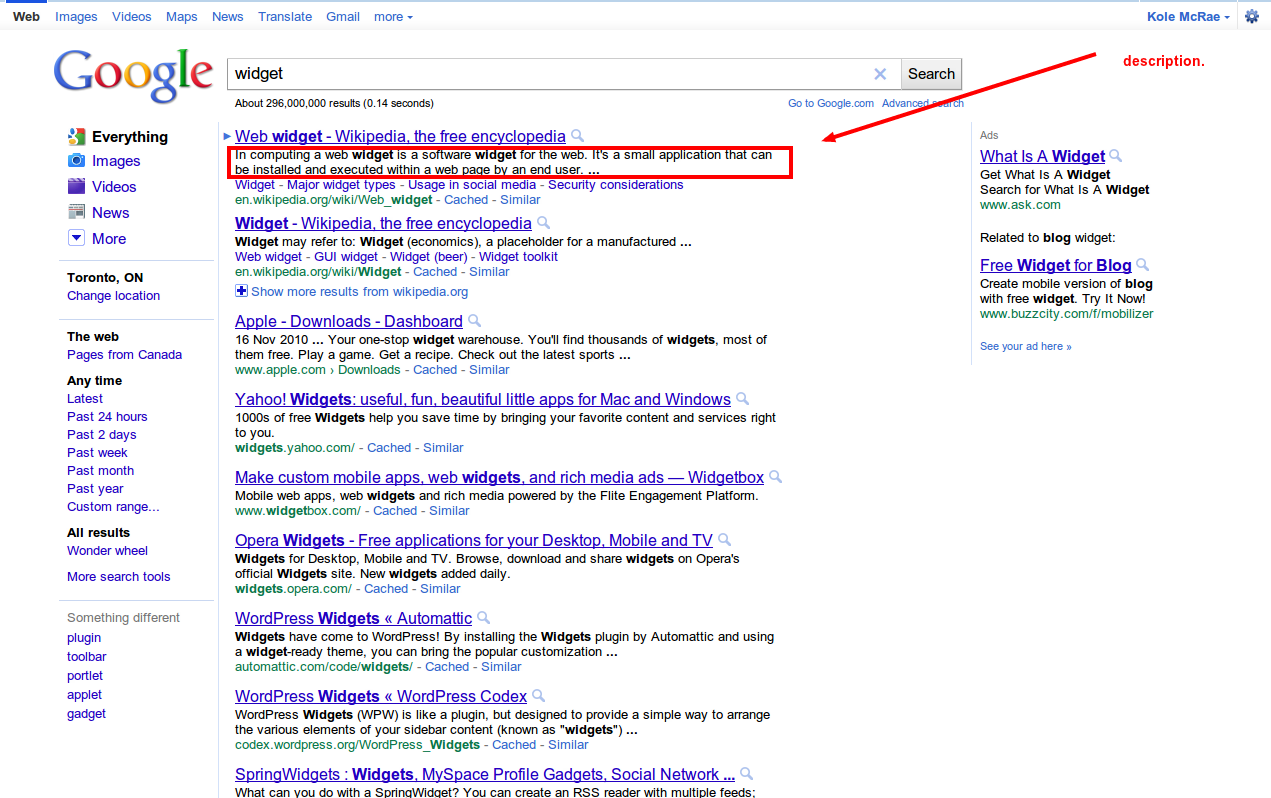
The Description tag

This is what Google (sometimes) uses to describe your site in the search results. It’s shown in the screenshot below.
This does not effect your rankings, but it can be used to help entice people to click on your link in the search results. Make sure it is relevant to your site, and describes what people will find when they click your link.
As you can see in the screenshot, the term that was searched for will show up in bold in the results. You can use this to help get more clicks—but don’t abuse it.

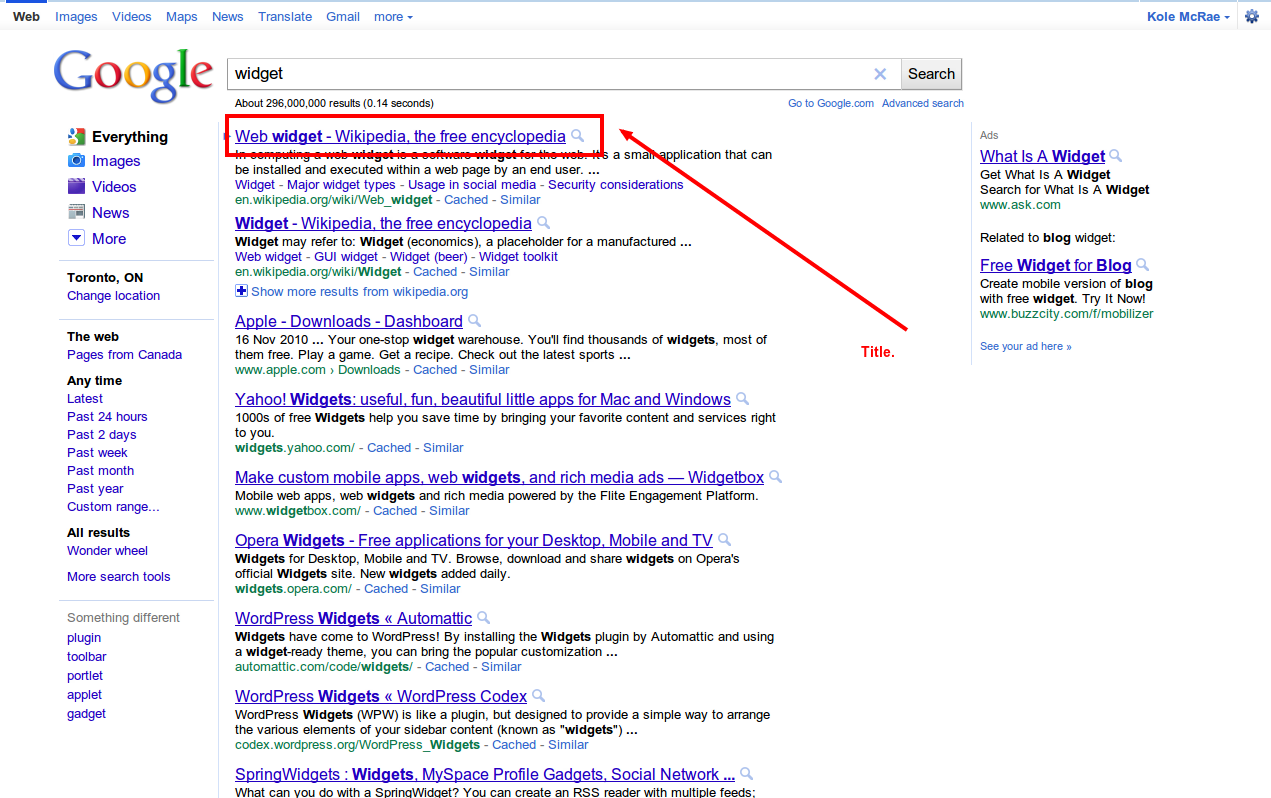
The Title tag

The Title tag is (sometimes) used by Google as the main text of your link within the search results, as seen in the screenshot below:
The words used here have been proven to help with rankings. Basically, the closer the keywords are to the left edge of the link, the better the result will rank for those keywords. For example, Geek Juice: Canadian Tech News won’t rank as well as Canadian Tech News by Geek Juice for the term “Canadian Tech News.”

“Sometimes”?

In both instances I said that Google sometimes uses these tags. This is because they sometimes use other sources. Google may display content from your site instead of your chosen description or title tag if Google’s algorithm believes it is more relevant. Google may also use content from DMOZ (the open directory project.)

Keywords

The tips I’ve seen online for on page SEO range from ill-conceived to downright frightening. People tout keyword densities and other strange points of data as the be-all and end-all of SEO. In reality Google hasn’t used keyword density in years. Stuffing a million keywords at the bottom of your page won’t help; some believe Google actually penalizes sites for this.
As long as you mention a chosen keyword once or twice within a blog post, you’ll be fine. The important thing is that the rest of the post is about that keyword. Google has figured out a lot of very complex ways to make sure your post is about the keyword you’ve chosen. For example if you’re talking about the keyword “Toronto Raptors” you’ll probably mention basketball and scores and various other basketball related information.
The best thing you can do when it comes to keywords is simply talk about the things you love.

Building links

Google first built its search engine on the idea of page rank: a page was probably relevant if a lot of people linked to that page. The more links to that page, the better. Early in Google’s life this approach was easily spammed, and to this day people continue to try and gain PageRank.
You’ve probably heard advice such as putting your link into blog comments and forums, and within your profile on social networking sites. The problem is that these days these links are all marked as “no follow” links. “No follow” tells Google not to use this link within its determination of the site’s ranking. So in the end, these links count for very little.
The only real way to build links is to create great content that sites want to naturally link to. The issue is that if you are a new blogger, your chances of getting a link are slim to none. There are ways to build them though…

Guest posts

Guest posts (such as this one) will almost always produce a really high-quality link to your site. Don’t guest post just anywhere, though. Google likes it when sites that are similar to yours links to you. So guest post on blogs that have similar themes.

Contests

Running a contest where you give something away is a great way to naturally product lots of links.

Viral content

If a single post or image of yours somehow gets to the first page of Reddit or Digg, you are guaranteed to get tons of links pointing to your site.

Social signals

Both Google and Bing have admitted to using social signals within search results. This is getting more and more prevalent.
However, it’s still a brand new part of SEO, and it hasn’t been thoroughly studied yet. What I can suggest, though, is that you make sure you have a Twitter and Facebook account and that you interact with your followers regularly.
Ultimately, all this advice amounts to one tip for achieving good search rank: create great, high-quality posts and interact with your readers regularly.
Are you doing this already? How’s your search rank looking?

Monday, June 20, 2011

4 Success Secrets of Infamous British Author, Jeffery Archer

Share/Bookmark
Love him or hate him, there is no denying the phenomenon that is Jeffery Archer. With 27 book titles to his name and international sales passing $250 million, Archer is a phenomenon.
So what can a man as successful as Archer teach you about blogging success?

Lesson 1: Blog about what you know

We have all heard that you should blog about what you love but, according to Archer, you should blog about what you know.
“I always say to people,” said Archer in an interview, “don’t write about goblins; don’t write about wizards just because they’re in. Write what you feel at ease with. Write what you feel good with.”
He gave the example of Jane Austen, whom Archer believes wrote well because she wrote about what she knew.
“Always remember Jane Austen. [She] lived in a small village, and wrote about her mother being unable to get rid of four daughters. Then she wrote about her mother being unable to get rid of three daughters. Then she wrote about her mother being unable to get rid of two daughters. Then she wrote about the daughter.
“And genius—you have to turn the page not only because of her wonderful command of language but because she wrote about what she knew about.”

Lesson 2: Be persistent

Archer’s first book—Not a Penny More, Not a Penny Less—was rejected by 13 publishers before being accepted. The 14th gave him a £3000 advance. Most people would not have had the persistence to keep trying after the first five or six rejections, maybe nine or ten if they were pushing it, but Archer kept pushing.
What was persistence worth to Archer? At last count, Not a Penny More, Not a Penny Less, has sold over 27 million copies worldwide. And that is just one of his 27 plus books.
So do not lose hope if a few blogs turn down, worse yet not respond to, your guest post submissions.  Do not lose hope if your blog does not open with a bang. Your big break might only be a submission away. Imagine if Archer had given up after the 13th rejection.

Lesson 3: Be a storyteller

The next lesson is that you do not have to be a great writer to be a successful blogger—but you do have to be a great storyteller.
What is the difference?
“I tell audiences all over the world,” explains Archer, “that a writer is someone who is very well educated, who has a tremendous command of language. Patrick White is a classic example. He is unquestionably, unquestionably a great writer, won the Nobel prize and he’s brilliant.”
A storyteller, on the other hand, “begins once upon and a time, and prays.”
While his definition of a storyteller is a little vague, the point he makes is clear. You do not have to have a MA in English to tell a tantalizing story but you do have to tell a tantalizing story to be successful blogger.

Lesson 4: Understand the importance of the inner circle

A woman once asked Archer how he got through his prison sentence.
“I just want to know how did you get through those two years being confined in a cell when you had the world at your feet? How did you get through? I mean, I know if I was put in a jail cell I’d probably commit suicide, I couldn’t survive.  I just couldn’t do it.”
“I promise you,” replied Archer, “you’d be fine if your friends stood behind you. I promise you’d be fine. I was inspired by and kept going by my friends. If they’d run away from me, if they’d deserted me, you’re right – I’d have gone under, I’d have given in. But they kept me going.”
This is probably the most important lesson. In order to survive as a blogger, you need someone to believe in you. You need someone who shares your mindset, who thinks it can be done or at least will support you till you find out either way.
You look at most successful people and they have all had someone who supported them through their journey. Goethe had his brother, who sent him money nearly his whole life. Stephen King had his wife who never complained. Jeffery Archer had his friends.
But it does not have to be someone you know personally. You can find an online community, like this one, which will keep you positive and connected.
Have you applied these lessons in your own blogging career somehow? Share your thoughts in the comments.

The Perils and Pitfalls of Blogging in College

Share/Bookmark
In March of 2010, during my sophomore year at Elon University, I started a blog called the Jersey Jets Fan as a way to exercise my passion for professional football. What originally started as a hobby evolved into much more than that, as I constantly looked to further promote my blog and slowly began to monetize the site.
In January 2011, I launched my second blog, BROcrastinator.com in hopes of capturing a large piece of the male college demographic. While, I’ve had varying degrees of success and made a few dollars along the way, I’ve learned a lot about the blogosphere. Balancing the work load of college as well as maintaining a full-time blog is a difficult thing to do and it certainly has its benefits and pit-falls. Here they are, according to yours truly.

Pros

Real business experience

College is a time in which you’re supposed to learn everything you need to adequately survive in the real world. As a marketing student, I’ve learned my fair share of terms, equations and statistics in college, but only blogging has given me the real world experience that will help me to become successful in the business world.
In the past year and a half blogging, I’ve joined various affiliate networks, spoken with a ton of potential advertisers, hired/fired/kept bloggers, worked with different partner sites and created business opportunities for myself on the way. I’ve never made a lot of money, but it’s been enough to offset the costs of up-keep on my blogs and even to splurge on a few items like new golf clubs.

Resume booster

Whether you’re applying for an internship in the summer, grad school or a full-time job, include your blog in your resume. When I was applying for an internship in sports marketing, my experience as a blogger with the Jersey Jets Fan was one of the key factors that generated employer interest.
A lot of people say they are interested in a subject or have experience in something, but not many people have the dedication to maintain and run an effective blog. If you do, don’t be ashamed, write about it in your resume and it might help you earn that job you’ve been striving for.

Self-esteem booster

Never in a million years when I started blogging did I ever believe my articles would be featured on Sports Illustrated or talked about on the New York Times website. It truly gives you a sense of accomplishment when you work hard and someone notices by featuring your work.
As a blogger who only gets around 400 views a day, sometimes I get discouraged when reading the “quick and easy” success stories of other bloggers who reach a million views overnight. Even though I’ve never had a viral post or even broken 1,000 views in a day, it makes you feel good when someone acknowledges your work.

Cons

Lack of time

While I originally started a blog because I had spare time in college, I soon realized the amount of spare time I had wasn’t enough to take my blogs to where I wanted them to go. There were points in time in which I was too spread out, writing for too many blogs, concentrating on too many social media sites, talking in too many forums. You only have so many hours in a day, and I’ve learned that you must spend them wisely on what works well for you.
At one point, I was writing for a prestigious New York Jets blog in addition to my own. While I was at first honored by the opportunity and experience, I didn’t have enough time to put full effort into both. Something had to give and as much as it pained me, the prestigious blog wasn’t as important to me as my college grades or my own blog.

Lack of capital

Like many of you, one of the reasons I began to blog was because of the chance to make money. I was never hoping for much, just enough for some spending cash on the weekends. However, there have been times when I started to believe the saying, “You have to spend money to make money”. Well, like I just told you, I am cash strapped college kid with a few spare dollars here and there but nothing significant. It isn’t the easiest thing in the world to launch a good looking website with about $100 while others out there are spending thousands.
I’m aware that my blogs aren’t the prettiest thing your eye has ever seen, but I’ve done my best with the money and technological skills I’ve had. While some older bloggers may have the spare cash to drop $10,000 on a beautiful looking website, college bloggers might have to quit at a $50 premium theme. I’m not saying you need money to build a good looking and successful blog, but it certainly doesn’t hurt.

Overcoming the difficulties

When blogging in college, or on any time constraint, it’s important to make sure you know your priorities. While I place school work over blogging, when I’m not studying, I use that time to advance my blog. I actually spend a lot less time doing school work then I did before blogging because I know I have additional work to attend to when I’m done. The most difficult times can occur during mid-terms and final exams when the stress of multiple classes all come crashing down at once. Sometimes, you just have to put your blogging goals on the backburner for a week, even if your visits and page views have to suffer.
In regards to the lack of money many bloggers have, I’ve learned to make the best with what you have. I originally started with a free WordPress theme and then moved on to a Thesis theme with a premium skin as my blogs advanced. By re-investing almost all of the money my sites have earned, I’ve been able to improve the design and even spend a little money on advertising. While I sometimes wish I had thousands of dollars to spend on my blogs, the reality is I don’t. However, with some smart money management and a little creativity, you can stretch your dollar and take it a long way.
There you have it, those are some of my main advantages and disadvantages to the college blogger. I hope I’ve shed some light on the topic, especially to you college students out there who are looking to potentially start a blog. It’s a tough thing to do, but it is certainly well worth it. I’ve found in blogging that you only get out as much as you put in, but if you put forth a ton of effort, you can find huge rewards.

Related Posts Plugin for WordPress, Blogger...
Twitter Delicious Facebook Digg Stumbleupon Favorites More

 
Join Bloggerative on Facebook Follow Bloggerative on Twitter Subscribe to RSS Contact Bloggerative
Sponsored by iPhoneMY